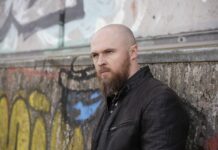
Swedish-born, Chicago-based industrial metal artist Arzenik has just released his debut full-length album, The Quantum Protocol.
The project belongs to Calle Johannesson, who blends cinematic soundscapes with sludgy grooves and scrap metal percussion, and writes and performs everything himself without any AI.
We caught up with Calle to talk ‘Godflesh meets Mick Gordon’, battling depression through song and the can of cider that helped write a track.
Who are you and where are you from?
I’m Calle “Arzenik” Johannesson and I currently live in Chicago, Illinois, USA. I’m originally from Västerås, Sweden, though, but moved to Canada in ‘99 and finally here in ‘22.
How did Arzenik begin, and how did you find your sound?
In a way, it began in 1991 with my first industrial metal project Neomystique with a friend, but that was abandoned prematurely with a lot of promise still lingering in my head. Then at a friend’s engagement party, I played an industrial metal cover of Kiss’ ‘God Of Thunder’ (which I have made available on streaming services as a standalone track). I had so much fun doing that, so I decided to keep going, but with my own original songs. It all coagulated nicely with my interest in cinematic soundscapes, the lingering ideas from the early industrial metal band, and a feeling that industrial metal itself could use a vitamin shot. So in 2024 I put the name Arzenik on the project and it’s been my main focus ever since.
How would you describe your music to someone discovering you for the first time?
In three words: cinematic industrial metal. To elaborate: imagine dense, dramatic and massive cinematic music driven by groovy heavy metal drums and scrap metal percussion. Then put some screechy synths on top of that and cover it all with gnarly and dark heavy metal guitar and growly vocals on top, and you’re getting close to having an idea.
You describe your sound as Godflesh meets Mick Gordon, with Melvins and Fear Factory in there too. How do those influences come together in your music?
Godflesh because of the heaviness and industrial foundation combined with a wall of distorted guitar sound. Mick Gordon was a milestone in industrial by modernising it, starting with the Doom game soundtrack and onwards. My guitar riffs are often sludgy and groovy by contrast, and that’s where Melvins come in; I’ve been a fan of theirs for a very long time. Fear Factory since my music has a similar death metal feel with double kicks and growly vocals.
What’s the story behind The Quantum Protocol?
The title refers to a quantum state of mind, meaning everything is a possibility, and the protocol is the process to find that something in everything to make it your ideal identity and escape the reality you are in today. It reflects my own life: I was in enterprise software when this project started, but now I am fully committed to a completely different life as an artist.
But in terms of the creation of the album… First of all, when I decided to make an album I didn’t want to just have a collection of songs. It needed to be a cohesive piece to experience as a whole. It wasn’t until after I had a few finished songs that the concept was clear, and those first songs also fit together well. That was close to two years ago that I felt it clicked and that an album was what I wanted to do. So not only does the music feel like it evolves throughout with a sense of progress and cohesion, but the topics are in that lane too. It tells a story of struggling internally with inner conflict, perception of reality, and getting to a point of self-understanding and peace. The first song is simply a recognition that “I am here”, the second goes into “the future has been decided and there’s nothing I can do about it”, but then continues with various struggles to not accept that kind of reality. The last song is a kind of ambiguous resolution that you are what you perceive yourself to be.
Are there any tracks on the album you are especially proud of, or that mean the most to you?
The song ‘Battle Lines’ is the most deeply personal of them. I was having a hard time battling depression at the time and decided to try to write a song that sounded like what it felt like to go through what I did. The mantra of “get back darkness, you will not conquer me” that I repeated to myself often also made it into the chorus. It’s a pretty quirky song from a traditional songwriting perspective, but I think the song achieved its purpose and earned a place as a single and a song on the album.
You’re clear that nothing in your work is made with AI. Why does keeping your art entirely human matter so much to you?
Simple: art is created by the mystery that is being human. Nobody knows how or why art comes out of a person the way it does, despite centuries of millions of published theories to explain it. I love that mystery and I think it’s a core principle of being human, and it’s something to protect and maintain.
I see great uses for AI and we’re in the steam engine era for it right now. It has more potential than we can imagine at the moment. I am not against AI holistically, and I do use AI myself in terms of help in tracking and prioritising the massive amounts I need to do as a solo independent artist without a team to keep me in line. But it never generates the art itself, and I don’t allow it to impersonate me by writing my emails or deep faking my social posts. Certainly not doing anything in creating my music; only I know what’s in my head and how I want to express it, so it’s a choice or decision only I can make. This way, me and anyone else who reaches out to me or listens to my music knows it, and a connection happens that is very much a human to human interaction.
Can you tell us a funny, emotional or dramatic story from your time making music?
I’ve had plenty of experiences since I got into the underground scene in the late ’80s. For Arzenik though, the song ‘Destiny Control’ was in a way co-written by a can of cider. For a social media post, I decided to take on the “will it riff?” challenge, where a barcode on a product decides what frets to play on a guitar. I had a can of El Chavo Mango Habanero cider next to me and threw something together rather quickly. The reaction, though, was that enough people told me it was so good that it should be developed into a full track. It turns out that it actually worked out after approaching it with my full attention as any other song, just with a rather unusual starting point.
What’s next for Arzenik?
The album’s release on 30 October means that the most immediate future is to promote this album now and to reach as many as possible, something that’s always difficult for a somewhat unknown artist who isn’t surrounded by a team to help execute on it. It does take a lot of effort, but I am fully committed to do what it takes while keeping my integrity intact.
In mid-November I will start to actively reach out to find opportunities to play live, but if anyone comes to me first before then, I’d be very excited. My live show, by the way, is me with my guitar, screaming over a backing track. That decision is to keep things honest. It’s been all me so far, and I feel the right thing to do at the moment is to own that and do as much as I can in person without losing the impact of what people hear on the recordings.
I am also about to start to write new songs so fans don’t have to wait too long to hear new stuff coming out.
Where can people find and follow you?
My music is available on all the major platforms under the name Arzenik. I’m also on YouTube, Instagram and TikTok as @callearzenik, and on Facebook I have an artist page as Calle Arzenik. People can sign up to my newsletter on my website, and it’s also where there will be merchandise and physical media for sale. To buy my album digitally, I’m on Bandcamp.
Thank you so much for your interest, and a big thanks to everyone who listens to my music, comes out to a show, and everyone gets bonus points for sharing it or saying hi to me anywhere.
The Quantum Protocol is out now.