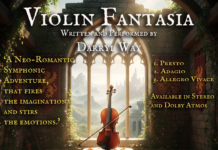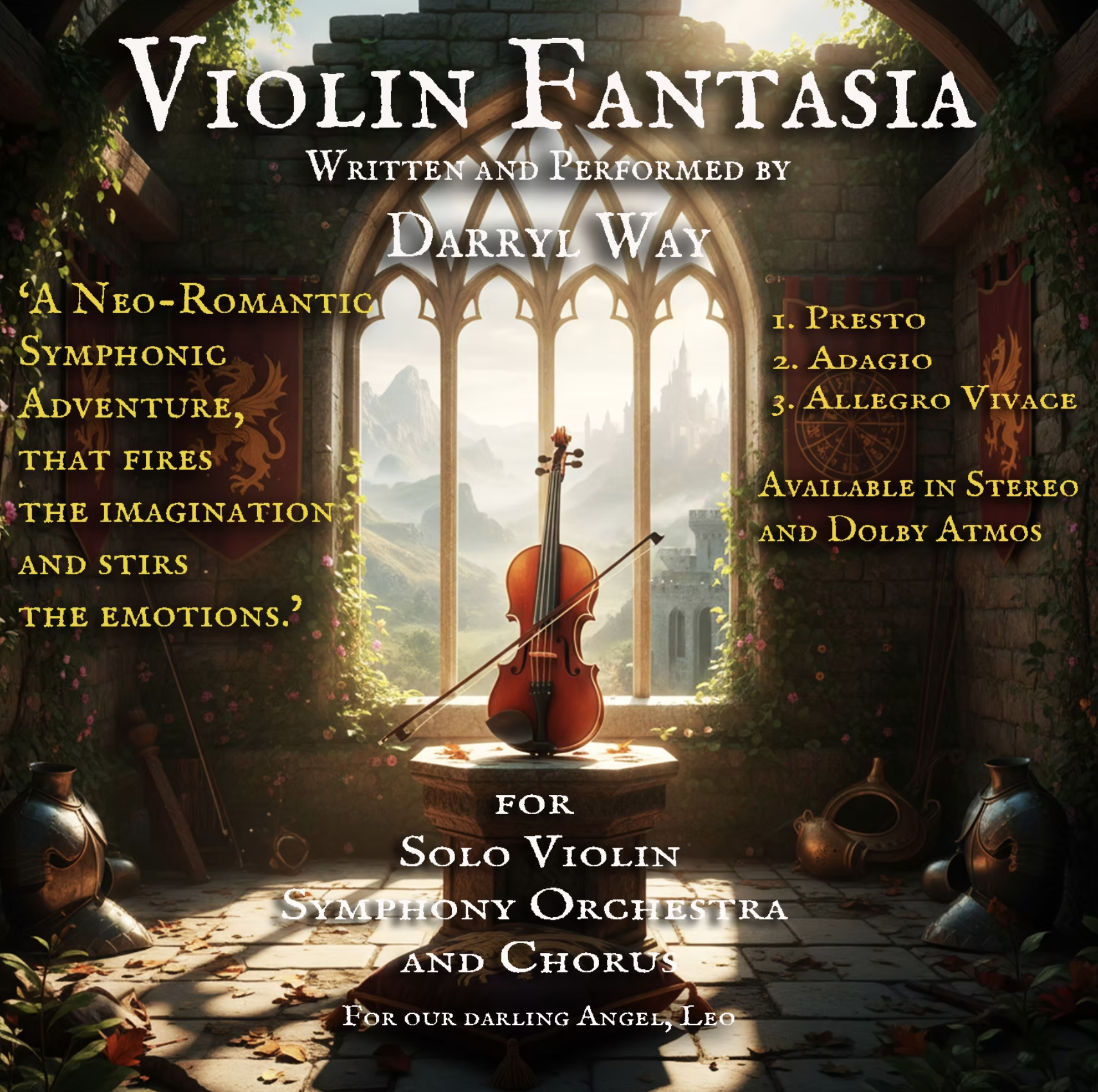
Best known as the co-founder and violinist of Curved Air, as well as playing keyboards and co-writing much of their music up to 1976, Darryl Way‘s Violin Fantasia will be released through Cherry Red Records on 20th February.
“This is my third large-scale violin piece and the one I’m most proud of,” Way revealed. “It’s born of 55 years of experience as a violinist and composer and in this piece, I have purposely pushed my abilities in both these fields, as far as they could go. To the extent that, whilst recording the solo violin part, I sweated bucket loads, in a hot studio, during a hot and sticky summer.”
Classically trained, Way wrote and performed the first ever Concerto for Electric Violin, which premiered on The South Bank Show television series, alongside the Royal Philharmonic Orchestra. He has also scored several films and television series. Between several stints playing with Curved Air, he formed progressive rock acts such as Darryl Way’s Wolf, played on Jethro Tull‘s Heavy Horses and released several solo albums. As an orchestrator, he has arranged music written by two members of The Police, namely Sting and Stewart Copeland (who had also been a member of Curved Air, albeit not concurrent with Way’s time), Procol Harum and others.
Mastered in stereo, as well as Dolby Atmos surround sound, Darryl Way‘s Violin Fantasia features three movements: ‘Presto’, a celebration of life and nature; ‘Adagio’, a reflection on longing and the people and things we love and miss; and ‘Allegro Vivace’, concerning new horizons, discovery and adventure.
“I call it neo-romantic,” Way said of his new music, explaining, “because it uses as a reference the glory days of orchestral music and the great romantic composers like Tchaikovsky, Brahms, Sibelius and Bruch, all of whom wrote magnificent violin concertos. Not that I would dare to compare myself to these great masters, they were just there in the back of my mind, acting as a guiding light. Therefore, the piece itself is tonal and predates the atonal movement that started at the beginning of the 20th century. Not that I’m averse to atonality, being a great fan of Bartók, but I just felt that there was still a lot more to say, using classical chord structures and melodies.
“I’ve called it a fantasia as opposed to a concerto, because a concerto implies that its overall purpose is to show off the technique of the soloist and, although the piece is very difficult, that was not the primary intention. The intention was to create an exciting orchestral work that showcases the ability of a symphony orchestra to transport the listener on a magical journey. Whether I have succeeded in that is not for me to say, but that was my intention. Anyway, I hope you enjoy it as much as I did creating it.”