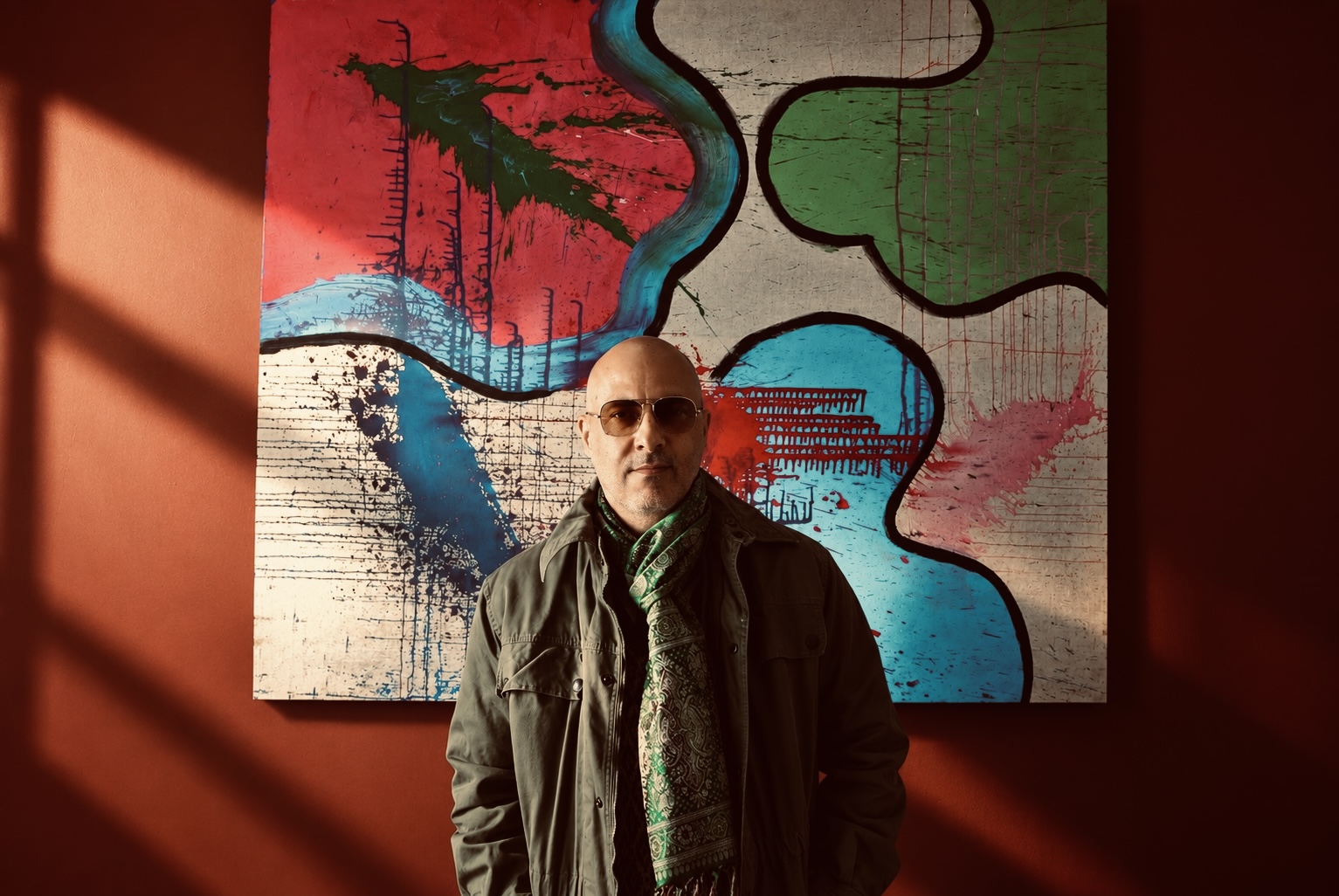
Formed in an Istanbul high school in 1993, Flying Dirty Clouds have spent more than three decades refusing to sound the same twice. Now led by founder Kerem Şahinboy, the project bounces between grindcore, symphonic doom, breakcore and beyond. We spoke to Kerem about new single ‘Opathian’, a lost album that came back from the dead, and why constant change is the backbone of the band.
Who are you and where are you from?
We’re Flying Dirty Clouds, a bunch of extreme music maniacs from Istanbul. We might be one of the most underground bands on the planet. Sometimes we’re so underground that even we have no idea what we’re doing.
Flying Dirty Clouds was founded in 1993. How did it begin, and how has the project evolved over three decades?
We were in high school, hanging out with fellow metalheads and constantly bringing tapes to school to swap. That tape-trading thing grew so much that, a few years later, I was practically running a medium-sized distro for crust, punk, noisecore and grindcore tapes. It was called Napalmer’s Bomb House. One day we thought, “Why don’t we start a band ourselves?” So we jumped straight in. None of us actually knew how to play our instruments. I guess people mistook our total lack of ability for authentic grindcore and liked us for it. 🙂
After gigs, demos and plenty more gigs, the other two founding members left, and I was on my own. I think some people eventually decide extreme music is a childish way to waste their time. I’ve never felt that way. I’m the only original member left. For the past five or six years, we’ve put out one or two singles almost every year, followed by music videos. I work with different musicians and keep bringing in fresh blood. I think that formula gives Flying Dirty Clouds a kind of immortality. That’s why we’re still here, more than thirty years later.
How would you describe your music to someone discovering you for the first time?
We’re an avant-garde club built around change. One song shouldn’t sound like the next. Being an artist means constantly shedding your skin. You have to read, learn and keep trying new things: different concepts, different guitar tones, different riffs. Habits can become an artist’s ball and chain. So one track might sound like doom metal or symphonic death metal, the next like rave or breakcore techno-grind, the one after that like grindcore-punk, and the next like some kind of folk a cappella piece. To us, that’s what being extreme and unconventional really means: constant change. To make that happen, we have to keep reinventing ourselves and leave the old stuff behind. I can’t say it’s easy. But it’s the backbone of Flying Dirty Clouds.
What’s the story behind ‘Opathian’, and the solitary astronaut in the video?
I came across the word “Opathian” a while back. A few songs earlier, we’d written lyrics and released a single around John Locke’s idea of tabula rasa. I imagine Locke would have been pretty surprised to hear his ideas turn up in a grindcore song. ‘Opathian’ is another stop along that same journey.
Everyone questions their life and their existence at some point. Could we have lived a different life? Is this really what we wanted? Is life long enough to make all our dreams come true? If it isn’t, why do we dream so much and then feel miserable when those dreams don’t happen? Would having fewer, smaller goals make us happier, or just indifferent and lazy? You could ask dozens of questions like that and still never find the magic formula for whatever is missing from your life.
The astronaut in the video and on the single cover represents that loneliness. It could be me, you or anyone else. He sets out alone, always trying to reach something, fulfil some dream or get somewhere. Along the way, people try to stop him. Hands reach out, obstacles tug at his legs. To do everything he wants, he’d have to split himself into three, five or ten different people. Eventually, he feels so hopeless that he loses the energy to keep going. Then, through his own strength, he manages to light up his heart again. But what about the people who lose that light for good?
What was Istanbul’s underground metal scene like when you started, and what is it like now?
When we started, the scene was much, much smaller, but it was also really close-knit. Almost everyone knew each other. A handful of bands, their members, girlfriends and relatives were enough to make a gig happen. I remember enjoying those shows for forty or fifty people more than anything. The scene has grown enormously since then. We’ve got all sorts of bands, big stages and huge festivals now. There’s a lot more colour and variety, and as someone in the audience, I’m probably happier with where things are today than where they were when we started.
You lead the project creatively and in production. What does independent production mean to you?
Freedom. That’s really the word for it. Recording has become so much easier. There are good and bad sides to that, but over the years, the studio I built downstairs at home has grown into something close to a professional recording studio. These days, we can make a piece of music without all the musicians being under the same roof at the same time. I record the guitars, send them to the drummer, then pass things along to the other session musicians. I’ve been teaching myself post-production, mixing and mastering, and I’ve learned a lot over the past ten years. I suspect I’ll be learning for a long time yet. As an artist, that gives me an enormous amount of freedom. I can do things exactly the way I want. I don’t have a producer breathing down my neck, but I also miss out on the brilliant ideas a producer might bring to a song. You have to weigh up both sides.
Are there any tracks you are especially proud of, or that mean the most to you?
That’s a tough one. It’s hard to pick favourites, but ‘The Poetic Anatomy of A Shattering Love’ probably has a special place in my heart. It’s a symphonic doom song with a duet between female and male vocalists. The cover photograph is by a Swedish amateur photographer called Charlotte Östmann. It’s a simple, unassuming, heartfelt image, but it hit me straight in the heart the moment I saw it. In fact, that photograph was what started the whole song. I took the loneliness of that tree and turned it into a story about human loneliness. We also used instruments like harp, piano, viola and cello.
The video means a great deal to me, too. It features a wonderful actress called Ashleigh Aston, who has also appeared in BBC series. It’s a breakup song. At the beginning of the video, the woman is full of life and enjoying herself. Then, little by little, the devastation of the breakup takes over. Her performance brought tears to my eyes. I’d really encourage everyone to watch it on our YouTube channel.
Can you tell us a funny, emotional or dramatic story from your time making music?
We recorded our album Destruction Hate Sonata under really difficult circumstances. We couldn’t pay what we owed the studio, so we couldn’t get our recording back. A while later, the studio closed, and the DAT tapes in its archives started passing from hand to hand. By then, the other two original members had left, and I was trying to figure out what to do next.
A few years later, our recording somehow reached a friend of ours, the vocalist of the Ankara band CENOTAPH. He passed the DAT on to another friend. Years later, the album finally found its way back to me. It was an incredible, surreal, completely absurd story. Something that seemed impossible had actually happened. I was as happy as if I’d been reunited with an old friend I’d been told was dead.
Because it had been recorded so long ago, we had the album remastered and released it. The whole story behind Destruction Hate Sonata gave me a huge push to keep the band going. It felt as though the universe was saying, “Don’t give up on this.” We’ve kept making music and releasing songs and videos ever since.
What’s next for Flying Dirty Clouds?
We’re not a commercial band. We never have been, and we never will be. But I do think we occupy a very particular little corner of progressive, extreme, experimental music that’s entirely our own. We have a small but loyal following. There’s still plenty we want to say, and so much left to try and explore. We’ll keep making songs that surprise us as much as the people listening: songs that catch you off guard, shock you, and get you thinking and learning at the same time. We don’t see our videos as just an extension of the songs, either. So I think the videos we make from here on will become more cinematic, more like works of visual art in their own right. We’re currently working on ‘Carrion Cloud Communion’, our next single. It’ll be an old-school death metal song with all that ’80s saturation and flaws.
Where can people find and follow you?
As an atheist and an anarchist, I’m constantly pushing back, at least on an ideological level, against political Islam and the government in my country. Whenever their posts pop up on Instagram, Twitter or other social media, I tend to open my mouth and say a few “nice” things. We’ve had our Instagram accounts permanently shut down five times so far. That’s why Flying Dirty Clouds’ only official outlets are our YouTube channel and our email address. My final words? Down with political Islam.