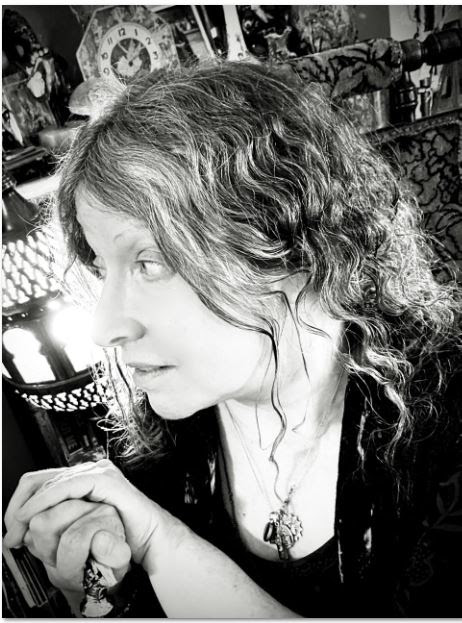
Nina Antonia is a music journalist and author who’s been around the block more than once, and her specialist subjects are those whose lives are lived ‘out there’ on the edge. She describes herself as a ‘chronicler of the decadent,’ meaning those souls who ‘live and die by night,’ and she’s published books about such artists, like the New York Dolls and Johnny Thunders, her biography of him being described as ‘gorgeously sordid.’
Dropping Like Butterflies, credited to Nina Antonia & The Lunar Moths, is her first album with a band, and it isn’t a musical album. Rather, it’s a poetry and musical collaboration where a poetess recites her words to a shimmering background of sounds, eerily sounding like the Velvet Underground in places, laid down by Neal X on guitar and Chris Musto on drums, with help from Mike Scott, who also mixed the album as well as played guitar, and James Hallawell, on occasional keys.
This is a low-key piece of work. Every song is quiet, with the backing understated and very sparse. When she recites the words (there’s no singing here) in a voice similar in tone to later-period Marianne Faithfull, she does so in a laconic manner, though she’s able to convey the meanings of her words, and she covers a wide range of themes and topics on the album, with her descriptive imagery evoking the pictures she’s attempting to convey.
An example is ‘Lodgers,’ an ode to those at the lowest levels living in bedsit land. ‘The Lord’s house has many rooms, but then so has my grandma’s,’ and the desperate lives of the ‘demi-monde of lost souls and wayfarers’ living in such unsanitary conditions are clearly portrayed.
For some people, life is just too robust for them to be able to cope, and in ‘Thames’ Doom,’ they fill their pockets and jump in to escape. Similarly the 18th-century poet, ‘Chatterton,’ unable to live by his words, ‘surrenders to devil demons’ and takes his own life by poisoning himself.
‘Lunar Moths’ live for only a very short period and this piece, at almost eight minutes, the longest on the album, looks at lost souls who take a ride on the rapids, hitch a lift to nowhere and don’t look back. Lost souls, she says, are those who ‘go missing from life but who leave something of worth behind them.’ She writes about such people with considerable empathy. There’s no moralising, she just tells it as she sees it.
Similar to Tom Waits, her work looks at those whose lives are lived out in quiet desperation, and the melancholy in her work comes across clearly. I’m unsure who the target audience is here but, whatever, this is a thought-provoking album.